Monday, May 9, 2011

GROUP HALL WAY DICE ROLL MANGA


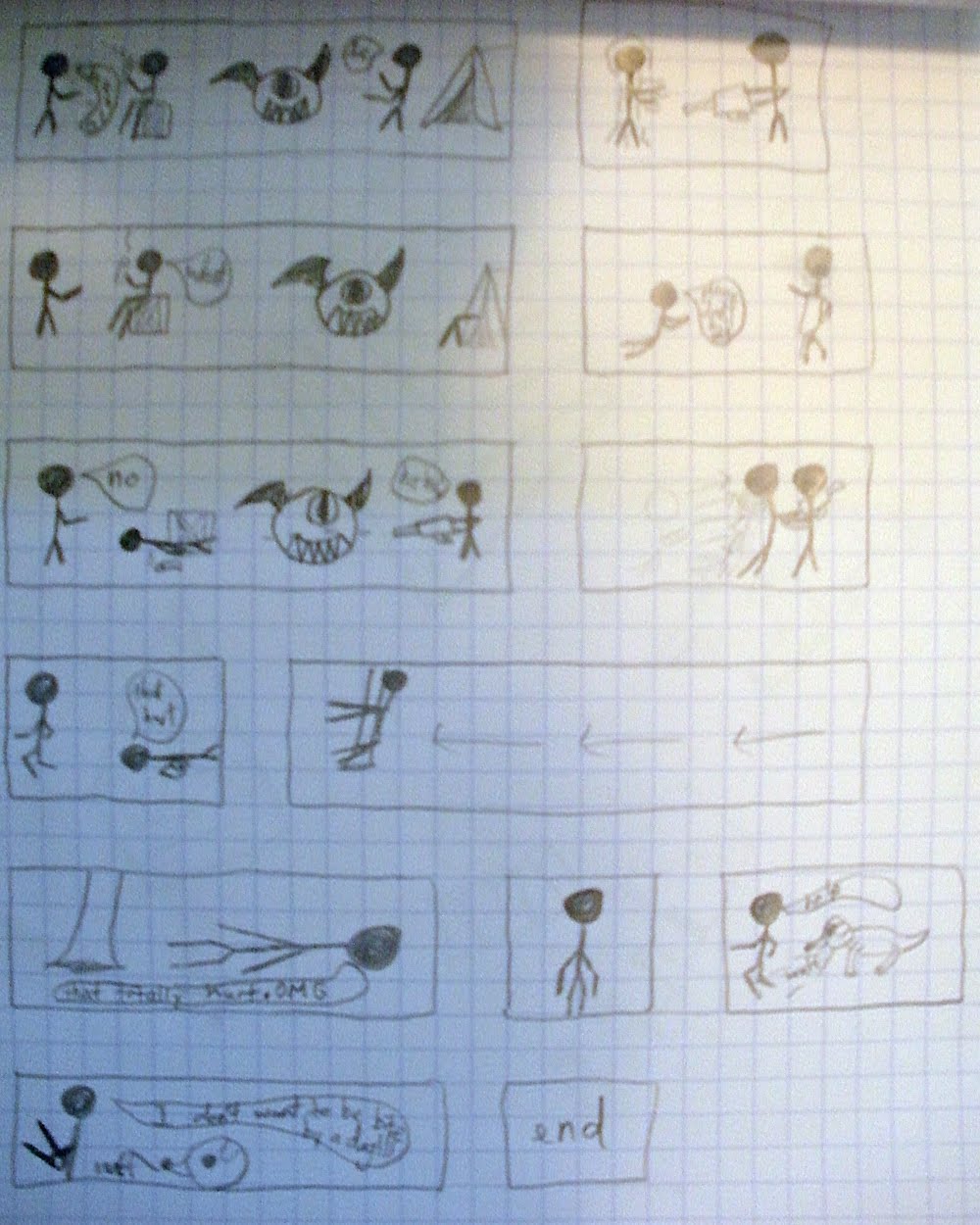
Most of you are involved with dice roll group projects. If you're not moving a story along, decorate and finish previous panels with cross hatching, color and added backgrounds. Once the concept of the story is created, the drawing can be fully utilized.

You're receiving five panel manga strips at the beginning of this class. Underneath the panels please write the Will Eisner story structure.

* Settings:

- the park
- the mall
- the movie theater
- A hotel
- A residential apartment
- A coffee shop
- Deep in the woods, late at night
- A club
- The bottom of the ocean
- The distant past
- On top of a mountain
- The rain forest
- The laundry mat
- A police station
- Outer Space
- In a cave
- Madagascar
- At a race track
- A Basketball court

Problems -

1. Romantic Nature
2. Life-Threatening Nature
3. Rivalry
4. An act of vengeance
5. Jealousy
6. An epic act of nature
7. The bending of time/space

Dealing with problem -

Your job

Solution -

Your job

End -

heads - happy ending
tails - sad ending

***************************

On an unrelated note, people need to broaden their definitions of what "good drawing" and "good art" is. Certain students are falling into the "if it doesn't look exactly like Avatar: The Last Airbender" it isn't worth anything and it isn't worth your time. This is silly, everyone's hand is distinct, everyone has a certain style that is unique to them. There is no point to mindlessly attempting to make your drawings look exactly like somebody else's. Sure, doing an artist copy is a good exercise, but no matter how hard you try, it is impossible to make an exact duplicate. Your style is developed over time, through endless drawing and gradually perfected.

In the meantime, value your own work by how you present specific artistic principles.

EXAMPLE 1: GOOD COMPOSITION


It is appropriate to review. Here is a drawing DuJuan made last semester. While the figures in them are not figurative, rather iconic, the composition of the entire drawing is stellar.

If we break the paper into a grid, we notice that each area is drawn upon to varying degrees depending on significance. The weapon is placed in the center square giving it significance.

A drawer like DAMION can learn from this drawing. While Damion can render action heroes and environments well, I have YET TO SEE HIM FILL ONE PAGE OF MANGA!!! You must consider the entire page, and DESIGN the page! It is not enough to do good figure drawings.

If you're working in a group, continue to do so. If you're not actively working on a group wall drawing, please do a 5 step dice roll manga.

Wednesday, May 4, 2011

TODAY

Please take a break from individual projects to take place in two group activities. I'm excited people like Nygel and Danilo are working together. It shows entrepreneurship, problem solving skills and creativity. But today, I'd like to make groups so people can learn from one another better.

ACTIVITY 1:

20-8-COIN

ACTIVITY 2:

SUPER STRUCTURE WILL EISNER WALL STORY

Monday, May 2, 2011

IDEAS


Students are progressing with their understanding and ability to utilize drawing techniques. Students are developing with own aesthetics that combine figurative, abstract and iconic drawings. The drawings are becoming complex as we introduce perspective and cross hatching.

The class, for the most part, however, is lacking in narrative and ideas.

Manga is created in fragments. Each fragment is an idea.

"An idea is a thought. It's a thought that holds more than you think it does when you receive it. But in that first moment there is a spark. In a comic strip, if someone gets an idea, a light bulb goes on. It happens in an instant, just as in life.
It would be great if the entire story cam all at once. But it comes, for me, in fragments. That first fragment is like the Rosetta Stone. It's the piece of the puzzle that indicates the rest. It's a hopeful puzzle piece.
You fall in love with the first idea, that little tiny piece. And once you've got it, the rest will come in time." - David Lynch, Film Director, Painter, Cartoonist

Let us observe the many FRAGMENTS that have been created in this class.


Lyquan did a portrait of yours truly. His proportions in the figure improving! Remember the
"Adventures of Link" cross hatched drawings (see the last blog post). These arms are in perfect length, even though the hands are a little small. I believe this is an improvement because he's LOOKING at me while he's drawing, AKA - LIFE DRAWING. Drawing from life will always improve your drawing ability. Also, lots of cross hatching. Good stuff!

While there in narrative in this drawing, it is still just a fragment. This picture, in order to be manga, needs a sequential PANEL that connects it and throws the story in the future.
Once again, he is a very well proportioned figure drawing and a nice tonal portrait. However, once again, these are just FRAGMENTS. Who is this person? Where is he? Why is he in a mask? Is he hiding? Remember, this class is SEQUENTIAL. Very good drawing technique, but let's further the ideas.
Once again, incredible drawing. Now it is time to work more than just figurative. use the WHOLE page.

Eric is working on a long term project, Michael is working on a long term project, ... and they're working in fragments. One panel at a time. You don't need to have the whole story plotted out, just a sense of organization by using Will Eisner's story chart.

If you are stuck, start with something you like. The top right corner - something you've been thinking about. Maybe it's just a room. Or an animal. Or an object. Then, think of a problem related to this setting, etc.


EXTRA CREDIT:

24 HOUR COMIC.

1. Take your notebook home. Pick a day, start at midnight: record when you wake up. Example: 7:30 AM. At 7:30 draw one panel documenting yourself at that present moment. At 8:30, draw another panel recording yourself that that present moment. Then at 9:30. Then at 10:30. Then at 11:30. Finish when you go to bed.

The drawings don't have to be super detailed. make this activity and fun; don't kill yourself with the drawings.

Bring in the 24 hour comic on the next manga/anime class.

Wednesday, April 27, 2011

EFFORT IS SUCSESS


One of my favorite quotes on the subject of art is from David Hockney; "To be a good artist, all you need is your hands, your eyes and your heart." Hands decipher your individual style; even within a genre such as MANGA that is very stylistic and uniform in comparison to the wide variety of styles found in western graphic novels, each individuals hand is noticeable. You need your eyes to see the world around you for inspiration. This is why I consistently push you all to draw from life, copy from manga, etc.

But the heart is the most important. It sounds cliche and students here at Edwards have made good points as to JUST effort can't make success, but I want to use this blog post to show how just a LITTLE more effort can make a big difference.

The above panel is from Lynquan. Keep in mind, this is an illustration, not a manga. Manga involves sequence and storytelling ... there are two active figures with a cross hatched background.
However, there is only ONE shading of cross hatching (two line). What happens when we take the corners and put 3 line cross hatching?

My thoughts: It centers the figures while also giving a larger tonal range. The larger tonal range from the new cross hatching makes a more dynamic illustration.

Isis has put a lot of effort in this class and she has been doing great! In this case, lots of effort is here. My only critic is that when doing perspective drawings, TRUST THE GRID. The buildings are in perfect perspective. The truck is fantastic and truly makes the illusion of going back in space. However, observe the bricks. They are not in perspective.

The blue lines are iconic brick lines that follow the grid. Great job! Interesting/dark subject matter. I wonder what the story of this tied up girl is ...

The first panel of Erik's new manga. GREAT! He is following the Will Eisner story structure ... the first panel is the introduction, the setting ... a car on the highway. ALSO: FANTASTIC perspective and FANTASTIC tonal shading. Great manga!


Here is the second panel in the manga Erik is currently working on. An interesting beginning story! I am already intrigued? Stealing an egg? Keep going here :-) ...

My comment is about composition. Notice the top half of the composition. It is empty! The text below is cramped and hard to read.


Look what occurs when we consider COMPOSITION. By enlarging the text and placing it on the top half, we get clearer text and a more visually pleasing panel.


Deshaun made his "WHAT IF" manga in three panels. The pure black in the middle panel is a nice design decision; it centralizes that panel; it makes a funny joke that if me, Mr. Turnbull, became a manga artist, I'd becoming a demanding rich jerk with a butler. Deshaun gets the facial expressions PERFECTLY. However, he needs to consider composition and also draw more iconically.


Notice what occurs in the last panel with a little iconic drawing. Just a simple money bag with a dollar sign on it makes a HUGE difference. Also - I am FLOATING in SPACE in the first panel! What is the environment? It makes a big difference ...

TODAY: Assignment 1: For people wanting to work on figurative drawing, we are going to do a MANGA photo shoot where we will dress up in samurai clothing, pose, and then draw ourselves.

Assignment 2: For people WANTING to finish their comics from Monday, or from the "What If" assignment, this is your chance!

Assignment 3: Do a panel using PERSPECTIVE, CROSS HATCHING and A CONSIDERING COMPOSITION (AKA - the PANEL FILLED! NO EMPTY SPACE!).

Monday, April 25, 2011

Class examples


Here is an amazing example of using contrast in a comic book/manga. Isis is CONTRASTING the 1st and last panels. Sort of like a BEFORE AND AFTER.

I have highlighted these two panels in red.


Here is a fantastic illustration from Damion and Sigi. A great use of 1 point perspective.


Danilo's figure drawing is becoming superior. Also notice the varying "camera angels" he uses. There are wide shots, close ups, etc.


Deshaun is using GREY SCALE to get a wider tonal range. His hand is very loose, which gives the above illustration an energetic feel.

TODAY:

Look at the above examples and draw/write a response. Therefore -

1. ISIS EXERCISE: Write a story/draw a story with a contrasted 1st and last panel. The first panel and the last panel are the same, but the events which occur in between change the last panel.

2. DAMION/SIGI exercise: Draw a highly detailed perspective drawings with 2 figures in it.

3. DANILO exercise: Draw a one page story where the FIGURE'S POSE shifts dramatically through the story.

4. DESHAUN: Do a figurative illustration using grey scale.


Here's a great example of anime crosshatching.

Good luck! We'll post examples :-).

Monday, March 28, 2011

STATEMENT OF PURPOSE

This week, being MCAST week, we will be spending time watching movies - Astroboy and finishing Castle in the Sky. However, This blog entry is being handed out to outline to the majority of our time in this semester.

As you may notice, I finish one page a week for my job. I am attempting to double this, but I am attempting to double this workload.

Starting next week, I'll be asking the same from students. It is important to have a visual goal - last semester we made class magazines, this semester we will be transforming this blog into a full fledged web comic.

During the movie, I'd like students to write statements of purpose.

What would you like to focus on studying? What would you like to accomplish.

Here is a list of terms we have

Writing

Empathy
Mundane vs. sublime
Metaphor
Will Eisner's Story Structure

Drawing + Design

Iconic drawing
Abstract drawing
Figurative drawing
Grid Theory and design
3D perspective drawing

Genre

Sci Fi as social commentary
Autobiography
Humor
Slice of Life
Fantasy

Please turn in a page telling me about your ambitions.

Thank you.

Wednesday, March 2, 2011

PERSPECTIVE DRAWING

http://www.youtube.com/watch?v=0PmlVdZNCDg

The above link is a well done youtube video demonstrating how to do a perspective drawing.

Perspective drawing was discovered in the Renisansse and was so powerful at the time of its creation that people thought they were optical illusions. Seeing 3 Dimensional space on a 2 dimensional surface was brand new in society. It is hard for us today to wrap our heads around this because we have 3D movies, television, video games, but at the time perspective drawing was a scientific breakthrough!

However, the discovery of perspective didn't happen overnight. Rather, artists experimented and tried different formulas in order to create the illusion of 3D space on a 2D landscape.

Giotto uses primarily shading to make buildings go back in space. Each building goes to a different point on an imaginary horizon.

However, illusion of dimension is created by the use of SHADOW.

In class today, everyone will construct an imaginary perspective drawing WITH AT LEAST THREE OBJECTS (IE Houses, cylanders, etc) going into distance. I will demonstrate a perspective drawing on board at first.

After this is done, look at your comments in your notebooks. Continue on your individual projects based on the comments given.