Monday, January 31, 2011

INTRODUCTION TO GRAPHIC STORYTELLING AND VISUAL NARRATIVE IN MANGA


HELLO STUDENTS!

I hope you are all staying warm and feeling healthy. Welcome to a new semester here at Edwards Middle School!

Last semester the manga class studied the concept of sequential art; we covered different types of drawing and how different types of drawing can tell specific stories. We also talked about page layout and composition and we talked about various drawing techniques.

However, powerhouse layouts or excessive figurative rendering techniques, which can overwhelm and distract the reader and dominate the story, are counterproductive to the form. Remember that a manga is a book - what is significant in the end of the day is that a story is told.

This semester we will focus on using our drawing vocabulary to tell graphic stories, or, manga! We touched a little bit about this last semester - now we will go full throttle into storytelling.


Quick review of the ficiton flow chart. All fiction goes through this process.

TODAY:

THE READER

To whom are you telling your story?


There is a classic, cliche image of an old man telling a story. This is because the success of a story depends on the storyteller's own memory of experience and visual vocabulary. The elderly have experienced much, have learned much. As storytellers in training, you must all work every day towards this goal. Increase your vocabulary, live your lives! But most importantly, attempt to gain understanding of the people around you.

Why do we like listening to older people tell us stories? If you think about it, all of your favorite manga titles are written by people older than you. Bleach, Deathnote, Bearfoot Gen, Persepolis, Ran ... these are all stories told by people older than you, even older than me in most cases! What makes a story "good"?

This is a big question: But for today's assignment, we will be focusing on EMPATHY. Empathy is one way you can make a story appealing to your reader.

What is empathy?

the intellectual identification with or vicarious experiencing of the feelings, thoughts, or attitudes of another.


Empathy is the ability to understand another's joy or pain. The ability to "feel" the pain, fear or joy of someone else enables the storyteller to evoke an emotional contact with the reader. We see ample evidence of this in movie theaters where people weep over the grief of an actor, who is pretending while in an event that is not really happening.

Empathy is used to create "page turners", manga and graphic novels you can't put down.


Art Spiegelman's "MAUS" is a memoir of his father's experience in the holocaust during World War II. Jews are portrayed as mice while nazis are cats. As a result, we can empathize with the mice! Using visual metaphor is one way to create empathy.


Francisco Goya wasa 1700 Spanish romantic painter and printmaker. While the vast majority of his work was doing court paintings of Spanish royalty, he felt very strongly about the human condition. The third of May, 1814 is a very famous painting depicting an execution.

Notice the facial expression and the hand gesture of the man being shot. Instantly we have empathy for him. We can all relate to that face of panic and horror. This painting has made many people cry because the painter created EMPATHY.


Manga is a perfect form for creating empathy because the size of character's eyes are exaggerated. Here, from Berserk 19, the character Lucca comes to the aid of a young girl accused of witchcraft and being whipped. She leaps onto her because she feel empathy for the little girl.

Of course, empathy is not just for negative emotions. We can laugh and be happy too from relating to a character that is happy! This is why we laugh at comedies.

Princess Mononoke is about a young man empathizing with the characters around him. The characters are all at war, but he has a global view of the situation; as a result, he becomes a warrior for peace, attempting to have the characters around him EMPATHIZE with one another - to hopefully live in harmony.

CLASS ASSIGNMENT:

It is one thing to write a story, it is another to construct a "page turner". Using empathy is a great way to intrigue your reader. How do you get a reader to pick up your manga and not put it down? The readers has to CARE about the characters. The reader has to CARE about the setting. The reader must EMPATHIZE AND RELATE.

With drawings, with writing or with both, make me, the teacher, and reader, CARE about a character. This character can be you and you can write from your own personal experiences.

I'm giving you this assignment because this class will be hard. I will judge what you create accordingly. Why should I, the reader, CARE about what you are writing?

Write me something that will cause empathy. Make me cry, laugh or give me a deeper understanding of who you are. Why should I read what you write?

Please take 45 minutes to create empathy in me, your reader. This is a difficult task, which is why we will pause and discuss.

THE ONLY WAY TO FAIL THIS ASSIGNMENT IS TO NOT TRY.

Good luck!

t

he pain, fear or joy of someone else enables the storyteller to evoke an emotional contact with the r. We see ample eviKentardence of this in movie theaters where people weep over the grief of an actor, who is pretending while in an event that is not really happening.

Researchers argue that empathy results from our ability to run through our minds a narrative of the sequence of a pa

Tuesday, January 4, 2011

Choice Fair


I hope you are all rested and happy from the holiday break.

The semester is about to end. The choice fair is next week. I am handing out in class 8 page mini mangas for you all to complete. It is time to showcase what you have learned in class and express your talents. These mini mangas are due on Monday, January 10th. If you finish them at the end of class, fantastic. Please consider that these will be photocopied as black and white, so I would advice not to use color. Also please consider that these will be distributed in a small print run for school faculty, your close friends and loved ones. When you are done let me know what color paper you'd like them to be printed on.

If you are unhappy with your grades thus far in this class, this is your opportunity to change your grade. If you unhappy with the grades you've been receiving, this final project will count for 50% of your grade. If you are happy with your grades, this final project's grade can be waived (but do it anyway for extra credit and/or fun!).

I won't go into detail about the lessons on drawing and storytelling we have covered, but I will make a list to refresh people's minds.

* Iconic Drawing (McDonalds logo, Nike Shoosh, the gigantic tear drop on Sailor Moon)
* Figurative drawing (Focusing on observing the human body)
* Abstract drawing (Which reflects the emotional state of the artist at the time of creation)
* Perspective drawing (which creates the illusion of 3 dimensional space on a 2 dimensional piece of paper)
* Page composition (designing the page so it is attractive to the eye)
* The arch of fiction (introduction + problem + solving problem + solution + end = story)

Do as much as you can in class today. It is paramount these are brought in on Monday.

Thank you all. It's been a great semester and it is almost over. Most of you have truly transformed and bettered yourselves as manga artists. Please consider rejoining me next semester as we will be embarking on a very ambitious project that will strengthen your understanding of the English language, storytelling, ancient Greek history, and, of course, the secrets to drawing MANGA!

Monday, December 20, 2010

Pop Quiz

Today in class you are being given a pop quiz. Please keep in mind that a quiz in an art class is very different from say, a quiz in a math class. There isn't one right answer, only hypothesizes you can present and evidence to back up your hypothesis. If you make a convincing argument for your answer, this will present applied knowledge and that you've been paying attention to the principles in class.

Attached to this blog entry describing the test are 7 pages of manga or graphic novels. Choose 3 of the 7 pages. For each page, choose 1 panel and describe what type of drawing the artist is using; FIGURATIVE, ICONIC, ABSTRACT, PERSPECTIVE or COMPOSITION drawing.

Your answer can be more than just one type of drawing; for example, perhaps the artist's work looks both figurative and abstract.

Perhaps the artist is employing ALL 5 types of drawing.

Your grade will be produced from how well thought out your answer is.

Please ask questions before the test.

Ignore the writing after the manga/graphic novel pages. This will be for the second part of the class today.

EXTRA CREDIT QUESTION: On each page, how much time passes? Explain your answer.

Wednesday, December 15, 2010

Promps

Writing involves focus and concentration. So does drawing. However, the hardest part for many people is just starting. It's like jumping into a swimming pool for the first time, you don't really know what you're doing, it could be a giant failure, etc. But with comics, unlike swimming, everything can be corrected. Art is never finished, only abandoned.

For those writing and struggling, I have brought in writing prompts. These are the first sentences and last sentences from great novels, manga and comic books. They're sort of picked at random and their origins are not too significant.

If you're having trouble writing,

1. It was a pleasure to burn.

2. It was summer, I remember. I was ten or eleven ...

3. At last the land of magic has been reached. Beside a steaming geyser a tale is being spun, as follows:

4. I am a plastic man.

5. No one can help me. Not even you.

Start with one of these prompts. Write a one page free write from the prompt. Then when that is completed, see what has been written and Attempt to divide what has been written into 9 panels.

3 panels = beginning
3 panels = middle
3 panels = end

If you are feeling experimental, feel free to improvise your panel compositions. If there are action in your story, perhaps the action needs a bigger panel. Do you describe a setting? Perhaps a descriptive paragraph demands a larger panel to illustrate an environment.

In today's class there is no need to leave your desk unless you are getting materials. We will work up until busses are called (around 4:20). Push yourselves! Don't sell yourself short!

Moonface


Dujuan has been listening carefully in class and has been making lots of progress. Above is an illustration from his continuing manga series "moonface" which he keeps under wraps in his notebook.

DuJuan is using the entire page in this illustration. As proof I have divided the page into a grid. While the picture quality is bad and the fact this is only in pencil does not help, if one looks closely at the original sketch, each panel of the gird is filled with a type of drawing.


I have numbered each panel and will now articulate the types of drawing which is occurring in each panel.


Panel 1 is depicting the motion of Moonface's crazy sickle/sword. Using motion lines, which are abstract in nature the lines make the viewer's eyes go down to panel 5 which is the base of Moonface's weaponry.

Panel 2 is a head portrait of Moonface. Moonface is in profile view, not looking straight ahead. While this may seem rudimentary to some students, DuJuan's sense of the figure has increased dramatically since the beginning of this class. On week one he could only do straight on figures, now his figures are beginning to bend, contort and become "figurative".

Panel 3 utilizes iconic drawing that ALSO directs the viewers eyes toward panel 5. The drawing is iconic because the artist is not attempting to realistically draw a scarf. Rather, the icon of a scarf, communicates more. My point is - don't go nuts attempting to draw a realistic looking scarf when simply making black and white stripes will do.

Panel 4 is another unnamed character.

Panel 5 is arguably the most significant panel on the page. It is the collision point of the battle and the very center of the page. It is where the eye goes first.


If one looks at all the contour lines on the page, the abstract lines from panel 1 and 2, the iconic scarf from panel 3, you will notice that all lines are converging at the center, at the point of impact. This adds DRAMA.

While many could make the critic that DuJuan needs to work on his figure, I am less concerned with this. Getting better at drawing the figure will come in time with practice and patience. What Dujuan has done here has DESIGNED a highly complicated illustration using different drawing techniques (abstract, iconic and figurative - designed and composed upon a grid). As a result, 4 different types of drawing are being utilized.

This illustration is a knock out piece of work and should be inked for clarity's sake. Unfortunately, it is not a page of manga but can be used as a character sketch. It is only missing text.

Monday, December 13, 2010

Using drawing technique in Writing


In class, we have discussed iconic, figurative, abstract, perspective and compositional drawing. This is a lot. Let's review.

Iconic drawing uses the language of icons in order to communicate ideas.

For instance, the mcDonalds arches is an iconic. Therefore to draw the mcDonalds M using gold and red would be an "iconic drawing".

In manga, icons are everywhere. Artists make the decision to not draw figuratively or realistically in exchange for drawing iconically. This makes it easier to communicate ideas.

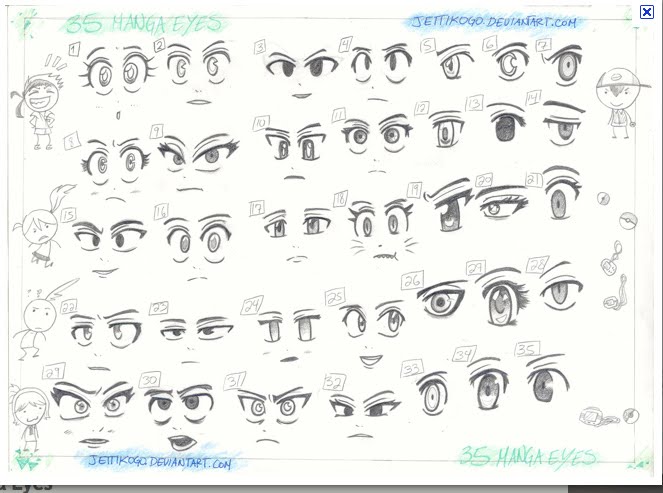
Eyes are usually iconic drawings. Eyeballs are usually never this big but are enlarged in order to illustrate expression. Nobodies eyes turn into spirals when they're super frustrated and to piggy back on the comment, nobody has a little "QUESTION MARK" over their head when they're confused. Question marks, steam out of ears, spiral eyes, - this is all iconic decisions because it communicates an idea over attempting to look realistic.


Abstract art is the opposite of figurative or realistic art; emotions are attempted to be expressed without any representation whatsoever.

In Manga, abstract art is usually used to portray motion, or to heighten the intensity of a illustrated situation.


Observe this still from the anime "Fist of the North Star". Ignore the figure with the lightning bolt coming out of him. Look at the background. It is red and black wavy lines. What does this do to the figure? Also notice how much the cool blue "pops" in front of the red. The same wouldn't occur with a blue background.

Figurative art keeps an emphasis on the HUMAN FIGURE.

To draw figuratively takes years of practice and patience. It also involves observing. To get better at figure drawing, draw people on the subway every day! Go to a life drawing class. The only way to get better at drawing is to draw.

Perspective drawing uses a mathematical grid in order to create the illusion of a 3-dimensional space upon a 2-D paper.


By finding a horizon line (where the earth meets the sky) and creating a single point on that line, then making a radius of lines that occur from the point, one can create the illusion of 3 dimensional space. This mimics nature. If you don't believe me, go to a street and look down the street.

Compositional drawing in manga is about designing the panels of a page that is pleasing to the eye. Luckily for this class, we have blueprinted paper, that tells us where the center of a page is, how to divide it, straight lines everywhere, etc.

****

Writing

We have discussed about the mundane and the sublime in writing. We have designed characters and have attempted to write descriptively. Stories have beginnings, middles and end can cannot exist without conflict or an issue. For instance -

Beginning: setting
middle: disturbance in this setting
end: resolution of disturbance.


Putting writing into comics is about composition. One must use the design of the page to emphasize a story. Panel scale can emphasize significance. For instance, let's pretend the end of our story is dramatic, similar to the ending of a horror movie when Freddie or Jason or whoever reveals they're not really dead.


If the ending is scary, why not give it one panel and make it very emotional and scary? You could utilize abstract drawing for a background to showcase power, the scale of the panel makes it stand out, etc.

If you are working from a script, different types of drawing may be used to showcase different types of writing.

For example:

"Nygel was late to school. He was stressed out and had to run to get to class."

to illustrate this statement could be boring, or interesting depending on how it is illustrated.

You could use iconic drawing to add big sweat beads to his brow. You could utilize abstract drawing to show motion lines of him running. A perspective drawing could show the hallway of the school.


I am using a 9 panel grid because it is common in American graphic novels. It is what I am used to. However, one can have their grid anyway they want it to be. Look at manga pages! See how pages are organized!

Thursday, December 9, 2010


Here is a revised panel that Nigel started and then abandoned. Here he experimented with perspective drawing, iconic drawing and figurative drawing.

The upper portion of Nigel's figure is very well proportioned. He employees ICONIC drawing with the face and hands - which may not appear figurative but communicate a human aesthetic. He then makes a railroad/sidewalk which connects to a point (great!) but makes no horizon line.

I've added a horizon line and have accurately relocated the telephone wires. I've left the wall mart out of perspective.

He also adds a wal-mart! Context! See how even the littlest of clear writing can make the page of a comic so much more intriguing?

This brings up the idea of SETTING. Mei Lei is great at depicting context and has done a series of landscapes which show environments.

Context! Environment! Write about where these stories are happening! Your backyard? China? Maine? Ethiopia? There's a world map to the left of the classroom. Is your environment even on Earth?

Writing and developing a background can turn into a character sketch! Just add some characters and you're set!

10 - 15 pages from working in groups! I want to see people's name signed at the bottom of each comic. Not even a

Also! CLASS COMPETITION! EXTRA CREDIT!!! WHO WILL DESIGN OUR CLASS LOGO? EVERYONE CAN DESIGN ... AND THEN WE TAKE A SECRET BALLET VOTING FOR WHICH ILLUSTRATION IS THE BEST! WINNER GETS THE OFFICIAL CLASS LOGO AND DESIGN CONTROL OF THE COVER!